
In the high-stakes digital economy of 2026, the concept of IT as a series of isolated tools is officially dead. The modern enterprise no longer survives on mere “software” or “hardware”—it thrives on an integrated IT Solutions Ecosystem. As a leading qualitymarketing.org partner, we have observed that the most successful organizations are those that stop viewing technology as a collection of individual costs and start orchestrating it as a unified engine for growth. This strategic shift from fragmentation to a cohesive ecosystem is not just a technical upgrade; it is a fundamental evolution in business intelligence.
Beyond Siloed IT: Why Your Business Needs a Unified Ecosystem
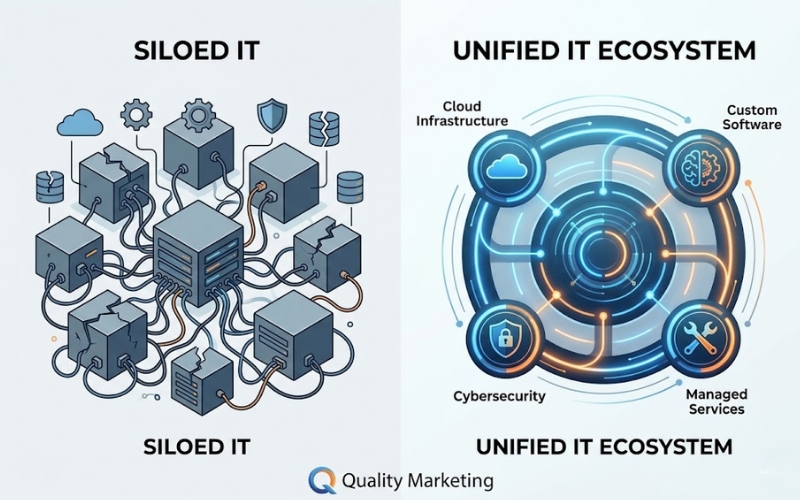
For decades, many companies fell into the “Spaghetti IT” trap: buying one platform for CRM, another for cloud storage, and hiring a different vendor for cybersecurity. While each tool worked individually, they lacked “interoperability”—the ability to communicate and share data seamlessly. This fragmentation creates “Data Silos,” where critical business insights are trapped in one department, invisible to the rest of the organization.
The Hidden Costs of Disconnected Systems
Disconnected systems carry a heavy price tag, often hidden under the guise of “operational friction.” When your software doesn’t talk to your infrastructure, your IT team spends 70% of their time on manual data entry, troubleshooting API conflicts, and patching security holes between disparate systems. This technical debt slows down your time-to-market and inflates your Total Cost of Ownership (TCO). In a unified ecosystem, these friction points are eliminated by design, allowing your talent to focus on innovation rather than maintenance.
Defining the IT Solutions Ecosystem as a Living Entity
At qualitymarketing.org, we define an IT ecosystem as a “living entity” where every component supports and feeds the others. Imagine a system where your cloud infrastructure automatically scales based on the traffic detected by your software, while your cybersecurity protocols instantly adapt to protect the new nodes being spun up. This is the power of a coordinated IT Solutions Ecosystem. It is a state of digital harmony that ensures your business remains resilient regardless of external market volatility.
The Four Strategic Pillars of a Resilient IT Ecosystem
To build a high-performing ecosystem, four core pillars must be architected to work in perfect synchronization. These are not separate services; they are the functional layers of your digital business.
Robust Foundations: Cloud Infrastructure
Your ecosystem is only as strong as the ground it sits on. Modern Cloud Infrastructure Services provide the necessary elasticity and performance required to power complex applications. However, the ecosystem approach goes beyond just “moving to the cloud.” It involves architecting a hybrid or multi-cloud environment that ensures data is always available, latency is minimized, and resource waste is eliminated through automated FinOps protocols.
Agile Operations: Custom Software Development
If infrastructure is the body, software is the brain. Off-the-shelf software often forces you to change your business processes to fit the tool. In an integrated ecosystem, Software Development Services are utilized to build bespoke solutions that adapt to your unique workflows. These applications are built with an “API-first” mindset, ensuring they can connect to any future tool you decide to integrate into your ecosystem.
Perpetual Vigilance: Cybersecurity Solutions
In an integrated environment, a breach in one area can quickly spread. Therefore, Cybersecurity Solutions must be woven into every layer—a concept known as “Security-by-Design.” Instead of an external firewall, security becomes a pervasive fabric that monitors data flows between your cloud, your apps, and your users in real-time. This proactive posture is the only way to defend against the sophisticated AI-driven threats of 2026.
Operational Continuity: Managed IT Services
An ecosystem requires constant tuning. Managed IT Services act as the nervous system, providing 24/7 monitoring and proactive maintenance. This ensures that minor anomalies are fixed before they become business-disrupting outages. Our approach is to move from “Break-Fix” IT to “Predictive Governance,” where data analytics help us foresee and prevent infrastructure issues before they impact your end-users.
The Synergy Effect: How Integrated Components Drive ROI
The Synergy Effect: How Integrated Components Drive ROI
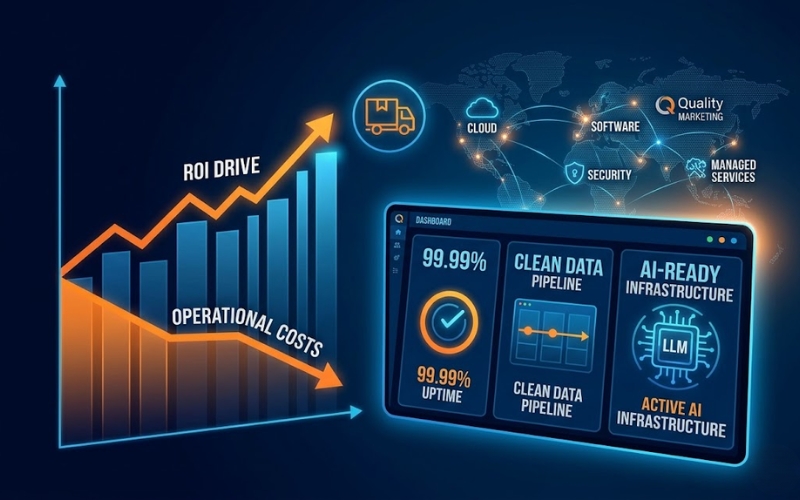
The true value of an ecosystem is found in the “Synergy Effect”—where the total performance of the integrated system is significantly greater than the sum of its individual parts. This synergy translates directly into financial performance.
| Operational Dimension | Siloed IT (Traditional Approach) | Unified IT Ecosystem (The Strategic Approach) |
|---|---|---|
| Data Accessibility | Trapped in silos; requires manual extraction. | Unified data lake; real-time visibility for all departments. |
| Security Posture | Reactive; “Patch-and-Pray” methodology. | Proactive; Zero-trust architecture integrated into the core. |
| Scalability Speed | Weeks; requires manual provisioning and testing. | Seconds; automated scaling through IaC and Cloud-native tools. |
| Cost Management | High “hidden” costs due to fragmentation. | Optimized ROI through FinOps and resource consolidation. |
By breaking down the walls between these IT functions, enterprises can achieve “Data Liquidity.” This means your data flows without friction from your cloud servers into your analytics software, protected by your cybersecurity layers, and monitored by your managed services team. This fluid movement of information allows for faster decision-making and a more responsive customer experience.
Future-Proofing Your Business with AI-Ready Infrastructure
As we move further into 2026, the primary driver for a unified ecosystem is Artificial Intelligence. AI requires massive, clean, and accessible datasets. If your IT systems are fragmented, your AI will be “starved” of the data it needs to provide accurate predictions. An integrated ecosystem provides the perfect “Data Pipeline” to feed LLMs (Large Language Models) and predictive analytics tools. By centralizing your infrastructure and software governance, you are effectively building a “Launchpad” for AI that can automate everything from customer service to supply chain logistics.
Interoperability: The Secret Sauce of High-Performing Systems
Interoperability: The Secret Sauce of High-Performing Systems
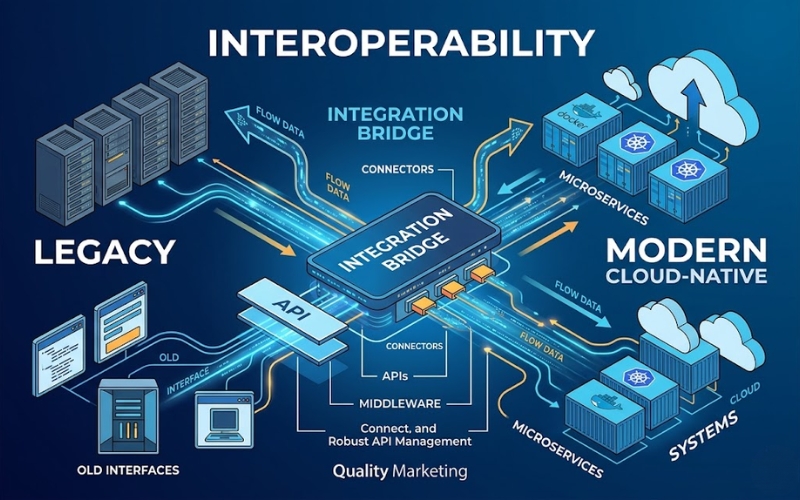
Technically, the “glue” that holds an ecosystem together is interoperability. At Quality Marketing, we focus on modernizing legacy systems through “Middleware” and robust API management. We don’t believe in the “Rip and Replace” strategy, which is often too expensive and risky for large enterprises. Instead, we build “Bridges” that allow your existing systems to communicate with modern cloud-native applications. This ensures that you can innovate at the speed of light while still extracting value from your previous technology investments.
We utilize Microservices architecture to ensure that if one part of the ecosystem needs an update, the rest of the system remains unaffected. This modularity is essential for maintaining 99.99% uptime while constantly evolving your digital capabilities.
The Quality Marketing Roadmap: Building Your Custom Ecosystem
Building a comprehensive ecosystem is a journey of transformation. Our proven roadmap ensures that your transition is strategic, secure, and aligned with your bottom line.
- Strategic Discovery & Audit: We analyze your current “Spaghetti IT” mess, identifying redundancies and security gaps.
- Architecture Design: We design a bespoke “Blueprint” that integrates your cloud, software, and security into a single, manageable framework.
- Orchestrated Migration: We move your workloads and data with a focus on zero-downtime, ensuring business continuity throughout the transition.
- Continuous Optimization: Once the ecosystem is live, we use AI-driven monitoring to constantly tune performance and reduce costs.
Frequently Asked Questions
The choice facing enterprises today is simple: remain tethered to the inefficiencies of fragmented IT or embrace the agility of a unified IT Solutions Ecosystem. Technology should never be a bottleneck; it should be the wind in your sails. By integrating your infrastructure, software, and security into a singular strategic entity, you are not just “fixing IT”—you are building a resilient, scalable, and future-ready business. At Quality Marketing, we are committed to helping you navigate this complexity, turning your digital infrastructure into your most significant competitive advantage.