
In the digital economy of 2026, the discussion around cloud migration has shifted from “if” to “how efficiently.” For a modern enterprise, infrastructure is no longer a silent background player; it is the core engine that determines speed-to-market, security resilience, and customer satisfaction. As a leading Quality Marketing partner for global digital transformation, we understand that building a cloud is easy, but building a cloud that doesn’t burn your budget while you sleep—that is the real challenge. This guide provides a deep-dive analysis into mastering Cloud Infrastructure Services to build a resilient, future-proof business foundation.
The Core Pillars of a Modern Cloud Infrastructure
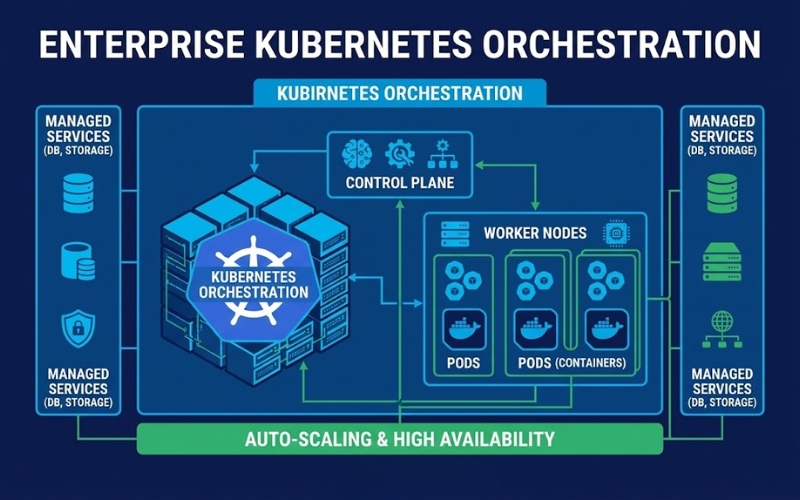
A high-performing cloud environment is more than just a collection of virtual machines. It is a carefully orchestrated IT Solutions Ecosystem where every component is designed to support the overall business objective. To understand how to deploy effectively, we must first look at the pillars that support enterprise-grade cloud services.
Compute and Orchestration (The Brains)
The compute layer has evolved from simple Virtual Machines (IaaS) to highly complex Container Orchestration (Kubernetes). For enterprises, this means moving away from “Pets” (servers that require manual care) to “Cattle” (disposable, automated resources). By leveraging professional Cloud Infrastructure Services, businesses can utilize Serverless computing, allowing developers to run code without managing servers at all. This not only reduces operational overhead but ensures that you only pay for the exact millisecond your code is running.
Scalable Storage and Data Sovereignty
Data is the lifeblood of the modern enterprise. However, with data comes the responsibility of compliance (GDPR, HIPAA, etc.). A robust cloud infrastructure must offer multi-tiered storage solutions:
- Hot Storage: For real-time applications requiring millisecond latency.
- Cool/Archive Storage: For historical data that must be kept for compliance but is rarely accessed, significantly reducing costs.
Our approach ensures that your data is not just stored, but is “locally compliant,” meaning it resides in data centers that meet your specific regional legal requirements.
Networking and Global Content Delivery
In 2026, user patience is measured in microseconds. A well-deployed cloud uses Content Delivery Networks (CDNs) and Edge Computing to bring data closer to the user. Whether your customer is in London, New York, or Ho Chi Minh City, their experience must be identical. This is achieved through Software-Defined Networking (SDN), which allows for the dynamic rerouting of traffic in case of regional outages.
A Strategic Roadmap to Zero-Downtime Migration
Migrating legacy workloads to the cloud is often compared to changing the engines of a jet while it’s in mid-air. At qualitymarketing.org, we utilize a refined, low-risk migration roadmap that prioritizes business continuity above all else.
The Cloud Readiness Audit
We begin by auditing your current technical debt. Not every application belongs in the cloud. We categorize your assets using the “6 Rs” of migration:
Rehost, Replatform, Refactor, Retire, Retain, or Re-purchase. This phase includes a deep scan of your application dependencies to ensure that moving one system doesn’t accidentally “break” another linked system in your on-premise data center.
The Landing Zone Setup
Before any data moves, we build your “Landing Zone.” This is a secure, multi-account environment that already has Cybersecurity Solutions integrated into its core. We set up the governance rules, the network firewalls, and the identity management (IAM) protocols so that when your apps arrive, they are instantly protected. This “Security-by-Design” approach is the only way to operate safely in the modern threat landscape.
Pilot and Production Rollout
We start with a “Pilot” application—one that is representative of your stack but not mission-critical. This allows us to test the migration scripts and performance metrics. Once the pilot is successful, we move to production using a Blue-Green Deployment strategy. This means we have two identical production environments; we update one and switch the traffic over only when we are 100% sure the new system is perfect. If an issue is detected, we simply switch back to the “Blue” environment in seconds.
Infrastructure as Code (IaC): The New Standard of Reliability
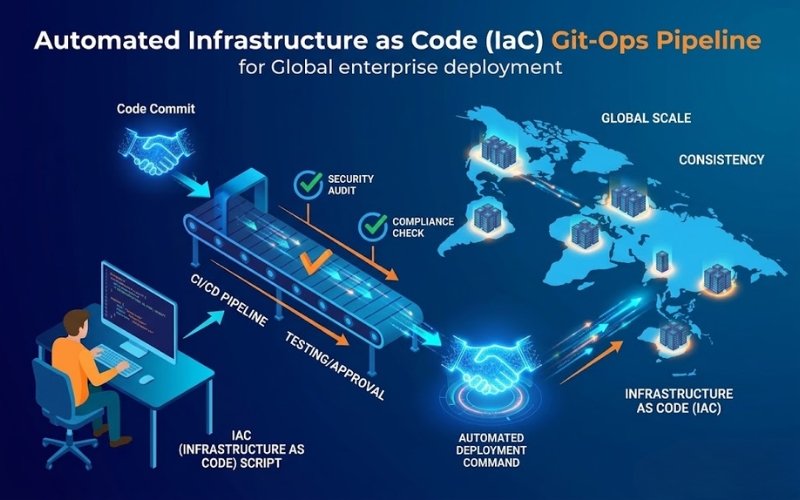
Infrastructure as Code (IaC): The New Standard of Reliability
Manual server configuration is a relic of the past. For a truly scalable enterprise, everything must be defined by code. Infrastructure as Code (IaC) allows us to treat your server room like a software project. We use tools like Terraform and Pulumi to write scripts that “spin up” entire global data centers in minutes.
| Feature | Manual Infrastructure Management | Infrastructure as Code (IaC) |
|---|---|---|
| Reproducibility | Low – prone to “Configuration Drift.” | 100% – environments are identical every time. |
| Recovery Time | Hours or days of manual rebuild. | Minutes via script execution. |
| Auditability | Difficult – who changed what? | Full – every change is recorded in Version Control (Git). |
| Scale | Limited by human manpower. | Unlimited – scale across 20+ regions simultaneously. |
Pre-Migration Checklist for Enterprise Leaders
- Have you identified all 3rd-party dependencies for your legacy apps?
- Is your team trained in cloud-native security protocols?
- Have you calculated the egress (data exit) costs for your cloud provider?
- Do you have a documented Disaster Recovery (DR) plan for the cloud?
- Are your Managed IT Services ready for 24/7 cloud monitoring?
FinOps: Controlling the Chaos of Cloud Spending
The most common complaint from CFOs regarding the cloud is “bill shock.” In an on-premise world, your costs were capped by the hardware you bought. In the cloud, an unoptimized script or a forgotten test environment can cost thousands of dollars in a single weekend. Our Cloud Infrastructure Services include a dedicated FinOps layer where we implement:
- Automated Shutdowns: Turning off development environments during weekends and off-hours.
- Right-sizing: Using AI to analyze if your servers are too powerful for their actual workload and shrinking them to save costs.
- Committed Use Discounts: Locking in lower rates for steady, predictable workloads.
Advanced Security: Zero Trust in the Cloud
The cloud is inherently shared. While providers like AWS or Azure secure the “physical cloud,” you are responsible for the “security IN the cloud.” We help enterprises transition from traditional perimeter security to a Zero Trust Architecture. This means that every single request for data, whether from the CEO or an automated script, is treated as untrusted until it is authenticated and authorized. Combined with our Software Development Services, we ensure that your applications are built with security “at the edge,” significantly reducing the risk of data breaches.
The Future of Cloud: Edge Computing and AI Integration
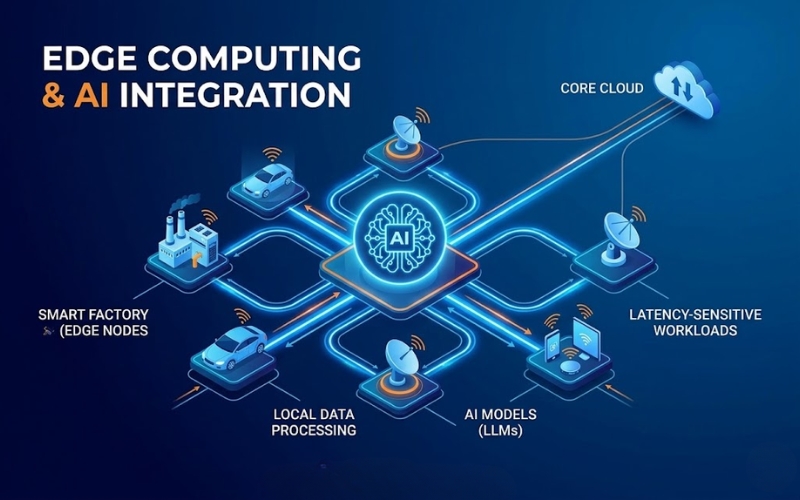
The Future of Cloud: Edge Computing and AI Integration
As we look toward 2027 and beyond, the cloud is moving closer to the user. Edge Computing allows for real-time processing of IoT data at the source, rather than sending it back to a central data center. This is vital for AI applications that require instant feedback, such as autonomous vehicles or industrial robotics. By architecting your infrastructure today with an “Edge-Ready” mindset, you are ensuring that your business can adopt the next wave of technological innovation without another massive rebuild.
Frequently Asked Questions (FAQs)
1. How does the cloud improve my Disaster Recovery (DR) capabilities?
The cloud allows for “Geo-Redundancy,” meaning your data is stored in multiple locations simultaneously. If one region goes offline, your systems can automatically failover to a different part of the world, ensuring zero data loss and near-zero downtime.
2. Is a Public Cloud or Hybrid Cloud better for my business?
It depends on your regulatory requirements. Public clouds offer the best innovation and cost, while Hybrid clouds allow you to keep sensitive legacy data on-premise while using the cloud for your high-traffic front-end applications.
3. What are “Egress Fees” and why should I care?
Most cloud providers allow you to put data into the cloud for free, but they charge you when that data leaves the cloud. Professional infrastructure design involves minimizing these fees through smart caching and internal data routing.
Cloud infrastructure is no longer just about “saving money on servers.” It is about gaining the agility to pivot your business model in weeks rather than years. It is about the peace of mind that your data is protected by the most advanced security protocols on earth. And most importantly, it is about creating a platform where your developers can build the future of your company without being held back by technical limitations. A strategic partnership with Quality Marketing ensures that your journey to the cloud is not just a migration, but a true digital transformation.