
In the rapidly evolving digital landscape of 2026, the migration to cloud environments has transcended being a mere operational choice—it is now a fundamental requirement for survival. For modern enterprises, infrastructure is no longer just a support function; it is the engine of innovation. As a premier Quality Marketing partner for digital transformation, we recognize that a robust cloud foundation is the prerequisite for AI integration, real-time data analytics, and global agility. Businesses that fail to modernize their core systems today will face terminal bottlenecks tomorrow. This guide explores how to build a cloud ecosystem that is not only functional but strategically superior.
The Strategic Imperative: Why Cloud Infrastructure is the Backbone of Modern Enterprises
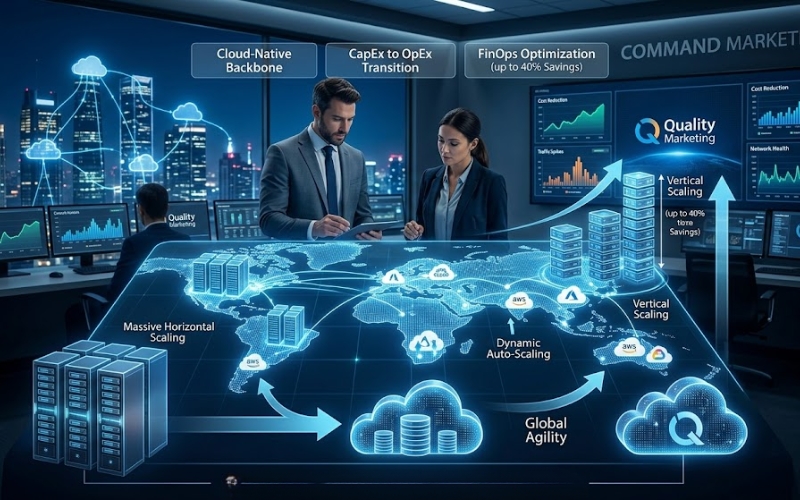
Cloud infrastructure represents a paradigm shift from traditional on-premise hardware management to a dynamic, software-defined ecosystem. When you transition to professional Cloud Infrastructure Services, you are effectively decoupling your business growth from the physical limitations of server rooms and maintenance cycles. This shift enables a “fail-fast, scale-fast” mentality that is essential for competing in volatile global markets.
Enhanced Scalability: The End of Over-Provisioning
In the era of legacy IT, infrastructure directors had to predict their traffic needs three to five years in advance. This inevitably led to “Over-Provisioning”—buying 500% more hardware than needed just to handle potential spikes, leading to massive upfront capital waste. Modern cloud architecture eliminates this guesswork through elastic scalability. At qualitymarketing.org, we implement architectures that utilize both vertical and horizontal scaling automatically:
- Vertical Scaling (Scaling Up): This involves dynamically adding more CPU power, RAM, or NVMe storage to an existing virtual machine instance. It is ideal for intensive computational tasks like monthly financial reconciliations or heavy data-crunching workloads.
- Horizontal Scaling (Scaling Out): This is the gold standard for high availability. We deploy additional server instances across multiple “Availability Zones” (geographically separated data centers). This ensures that even if an entire region experiences a power grid failure, your application remains online and responsive.
The Financial Revolution: From CapEx to OpEx with FinOps
One of the most significant advantages of a modern IT Solutions Ecosystem is the transition from high Capital Expenditure (CapEx) to a predictable Operational Expenditure (OpEx) model. However, many enterprises find that without expert oversight, cloud costs can become unpredictable. This is where we apply FinOps—the practice of bringing financial accountability to the variable spend model of the cloud. By utilizing advanced strategies such as “Spot Instances” for non-critical batch processing and “Reserved Instances” for steady-state production workloads, we help enterprises optimize their unit costs. Our goal is to ensure that every dollar spent on the cloud directly correlates to a measurable business outcome.
Our Comprehensive Cloud Deployment Roadmap: A Zero-Downtime Approach
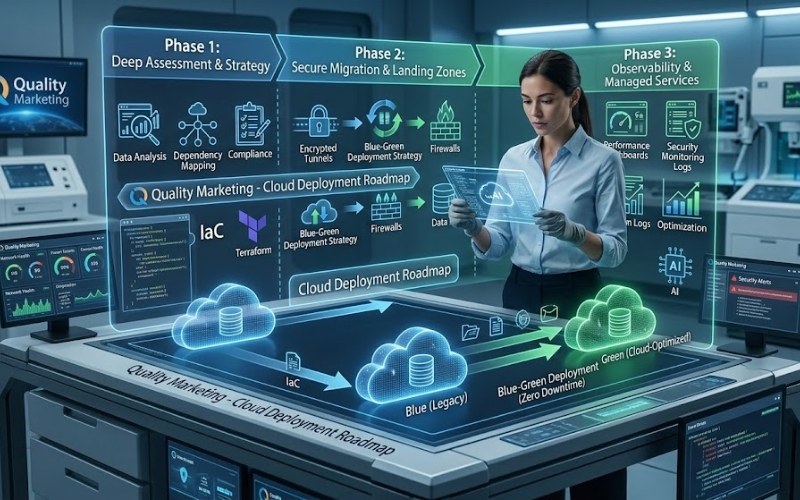
Our Comprehensive Cloud Deployment Roadmap
A successful cloud deployment is a surgical operation, not a “brute force” migration. We follow a strict, multi-phase roadmap designed to mitigate risk and ensure business continuity.
Deep Assessment & Cloud Readiness
The biggest mistake in cloud migration is the “garbage in, garbage out” approach. Before moving a single byte, we perform a comprehensive audit of your current technical stack. This includes dependency mapping—identifying how your legacy applications talk to each other to prevent “broken links” after migration. We also perform a compliance review to ensure that your move to the cloud adheres to data sovereignty laws (such as GDPR) and industry-specific regulations. We determine which applications can be moved as-is (“Lift and Shift”) and which require modernizing their code to take advantage of cloud-native features like serverless computing or managed databases.
Security-First Migration & Landing Zones
Security is not an add-on; it is the foundation. We begin by building a “Landing Zone”—a pre-configured, hardened environment that acts as the secure template for all future workloads. By integrating professional Cybersecurity Solutions from day one, we ensure that your data is encrypted at rest and in transit using industry-leading AES-256 standards. To ensure zero downtime, we often employ “Blue-Green Deployment” or “Canary Releases.” We build the new environment (Green) in parallel with the live legacy system (Blue), slowly routing small percentages of traffic to the new system. Only after the cloud environment is proven to be 100% stable under load do we fully decommission the old hardware.
Full-Stack Observability & Proactive Maintenance
Traditional monitoring is no longer sufficient for complex distributed systems. We implement Full-Stack Observability, which uses AI and machine learning to analyze logs, metrics, and traces. Through our Managed IT Services, we deploy “Self-healing” scripts. For example, if a database query slows down due to an unusual traffic spike, our system can automatically trigger a cache refresh or spin up a read-replica without human intervention. This proactive posture ensures that your IT department moves from “firefighting” to “innovating.”
Infrastructure as Code (IaC): The Future of Reliable Deployments
In the modern era, manual configuration of servers via a web console is considered a high-risk liability. To achieve true enterprise-grade reliability, we treat infrastructure exactly like software. We utilize Infrastructure as Code (IaC) to define your entire environment through scripts. By using tools like Terraform or Ansible, we can version-control your entire server room. If a configuration error occurs, we don’t spend hours troubleshooting; we simply “roll back” to the last known stable code version. This eliminates “Configuration Drift”—the phenomenon where servers that started identical become different over time due to manual tweaks.
| Strategic Metric | Traditional Legacy IT | Automated Cloud Infrastructure (IaC) |
|---|---|---|
| Deployment Speed | Weeks or months for hardware procurement. | Minutes via automated execution scripts. |
| Disaster Recovery | High risk; manual rebuilds take days. | Near-instant; redeploy the entire stack via code. |
| Human Error Risk | High; manual changes are rarely documented. | Zero; every change is audited, tested, and logged. |
| Operational Costs | High overhead for manual administration. | Low; lean teams can manage massive global fleets. |
Advanced Security: Zero Trust Architecture in the Cloud
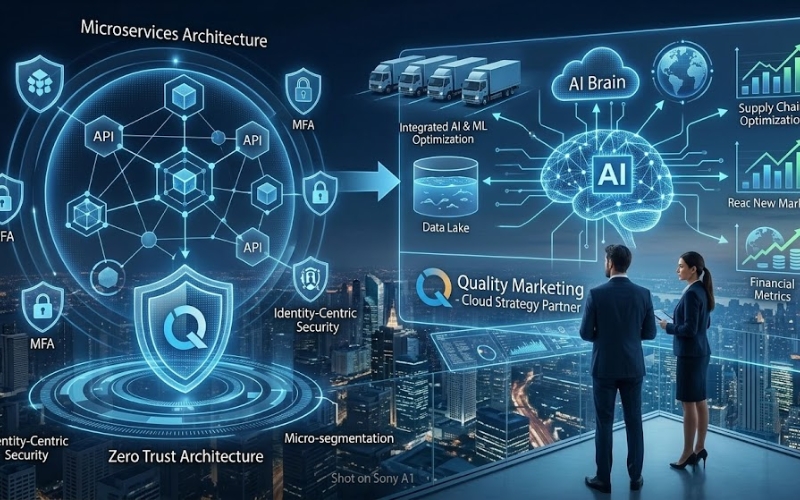
The traditional “castle and moat” security model is obsolete. In the cloud, the “identity” is the new perimeter. Our deployments are built on a Zero Trust model: “Never Trust, Always Verify.” This involves identity-centric security where every request for data must be authenticated via Multi-Factor Authentication (MFA). We also implement micro-segmentation, dividing your network into small, isolated segments. Even if one server is compromised, the “blast radius” is contained, preventing an attacker from moving laterally through your system. We use AI-driven SIEM tools to monitor for unusual patterns, triggering an automatic lockout in milliseconds if a threat is detected.
Microservices and the Path to Artificial Intelligence
Microservices and the Path to Artificial Intelligence
Modern cloud infrastructure is the primary enabler for AI and Machine Learning. Traditional “Monolithic” applications are too rigid to support the high-speed data processing required for AI. We help businesses transition to Microservices Architecture, where large applications are broken down into small, independent services. This allows you to update faster, scale selectively, and easily plug in AI models for predictive analytics or customer sentiment analysis. By containerizing these services with Docker and Kubernetes, we provide a consistent environment that runs perfectly across any cloud provider.
Real-World Impact: Case Study in Transformation
A regional logistics firm operating with a decade-old on-premise ERP was struggling with peak-season crashes, leading to lost revenue. Their internal IT team spent 80% of their time on hardware maintenance instead of business development. We migrated their workloads to a containerized environment and replaced fixed-cost servers with an auto-scaling cluster. The result? The firm achieved 99.99% uptime during their busiest season and reduced fuel costs by 12% through a new AI-driven route optimization tool that was only possible on a cloud-native foundation.
Frequently Asked Questions (FAQs)
Cloud infrastructure is no longer a luxury; it is the foundational utility for any enterprise that intends to thrive in 2026. A well-executed deployment roadmap transforms IT from a “cost center” into a powerful “growth engine.” By embracing Zero Trust security, FinOps for cost optimization, and Infrastructure as Code for reliability, your business gains the resilience to survive market disruptions and the agility to seize new opportunities. The journey is complex, but the competitive advantage gained is absolute. Building your future on the cloud is the most rewarding strategic investment your organization can make today.